Essential cookies keep the website and your basket working, so they're always on. Analytics cookies (Google Analytics and Microsoft Clarity) show us which pages people find useful. They stay off unless you turn them on.
A power station is a battery, an inverter and a set of sockets in one box. Charge it from the mains, a car or a folding panel, then plug in what you need. Two numbers decide what it can do.
Not for use with a plug-in solar kit Power stations charge from a wall socket, a car or their own folding panel. They never connect to a plug-in solar kit, and a plug-in kit must never be used with a battery.
Sort by any column
Power station matrix
Tap a heading to sort. Swipe the table sideways on a phone.
At the sockets: 85% of the stored energy, our planning figure. Panel refill: a 200W folding panel giving roughly 130W in bright summer sun, from empty. Each model's own figures replace these when it's listed.
Capacity vs output: the two numbers that matter
Capacity, in watt-hours (Wh), is how much energy it stores. It sets how long things run.
Continuous output, in watts (W), is the most it can supply at once. It sets what will run at all.
Surge is a short burst above that for motors starting. A fridge-freezer needs it for a moment every time its motor kicks in.
Appliance
Typical draw
Output it needs
Phone or laptop charger
15 to 65W
Any power station
Fridge-freezer
40W on average, more as the motor starts
A few hundred watts, plus surge
Microwave
1,000 to 1,500W
1,500W or more
Kettle
2,000 to 3,000W
3,000W for most UK kettles
Read both numbers before you choose. A big battery with a small output runs a router for days but won't boil a kettle.
Solar input and recharge times
Every station has a solar input limit: the most panel watts, and the voltage range, it accepts. Match the folding panel to it. A panel bigger than the limit won't charge it any faster.
Folding panels rarely give their full rating outside a test lab. In bright summer sun, expect roughly two-thirds.
Folding panel
Roughly puts in
Fills a 1kWh station
100W
65W
About 15 sunny hours
200W
130W
About 8 sunny hours
400W
260W
About 4 sunny hours
Estimates for bright summer days, from empty. A wall socket fills most stations much faster. Each model's own times go on its listing.
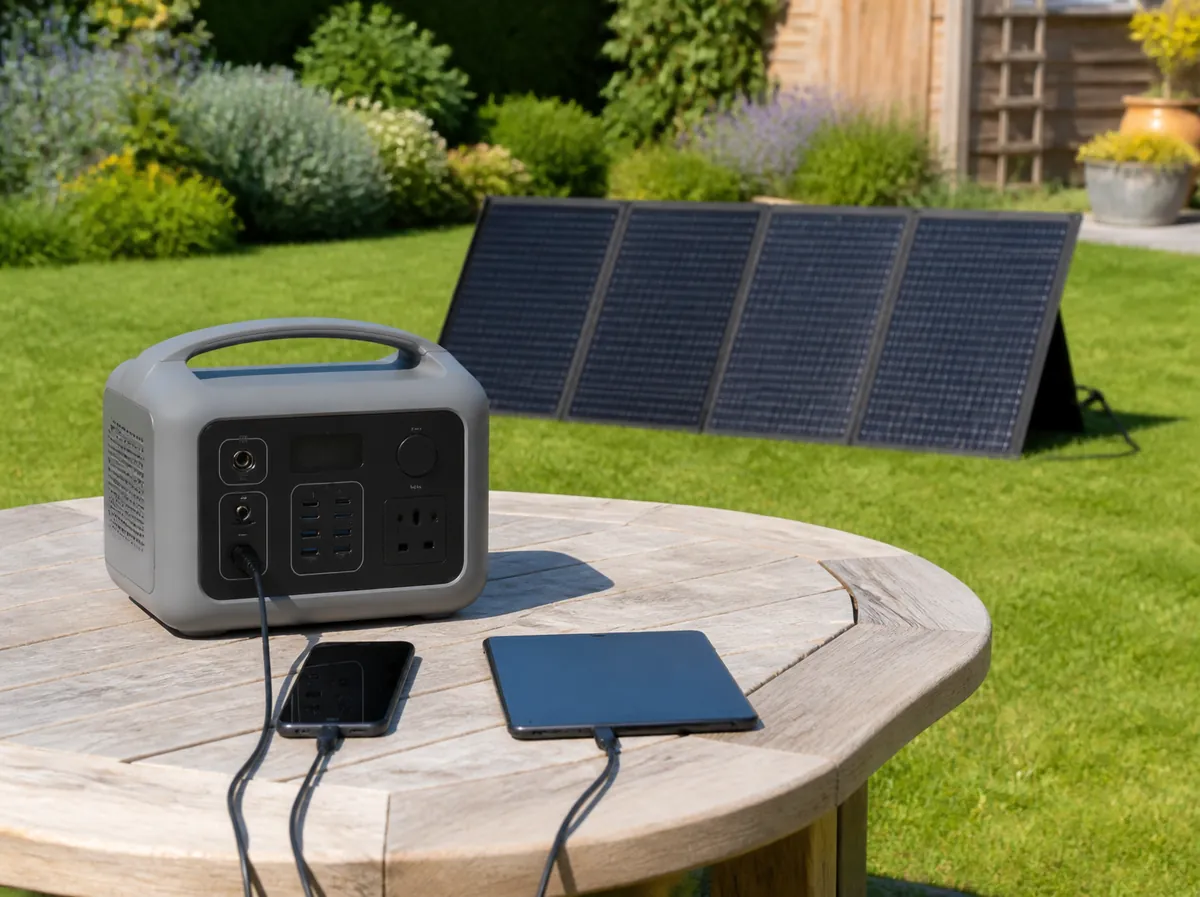
Face the panel at the sun, and turn it once or twice through the day. Keep the station itself in the shade.
Illustrative image
Taking it away
Carry weight and handles
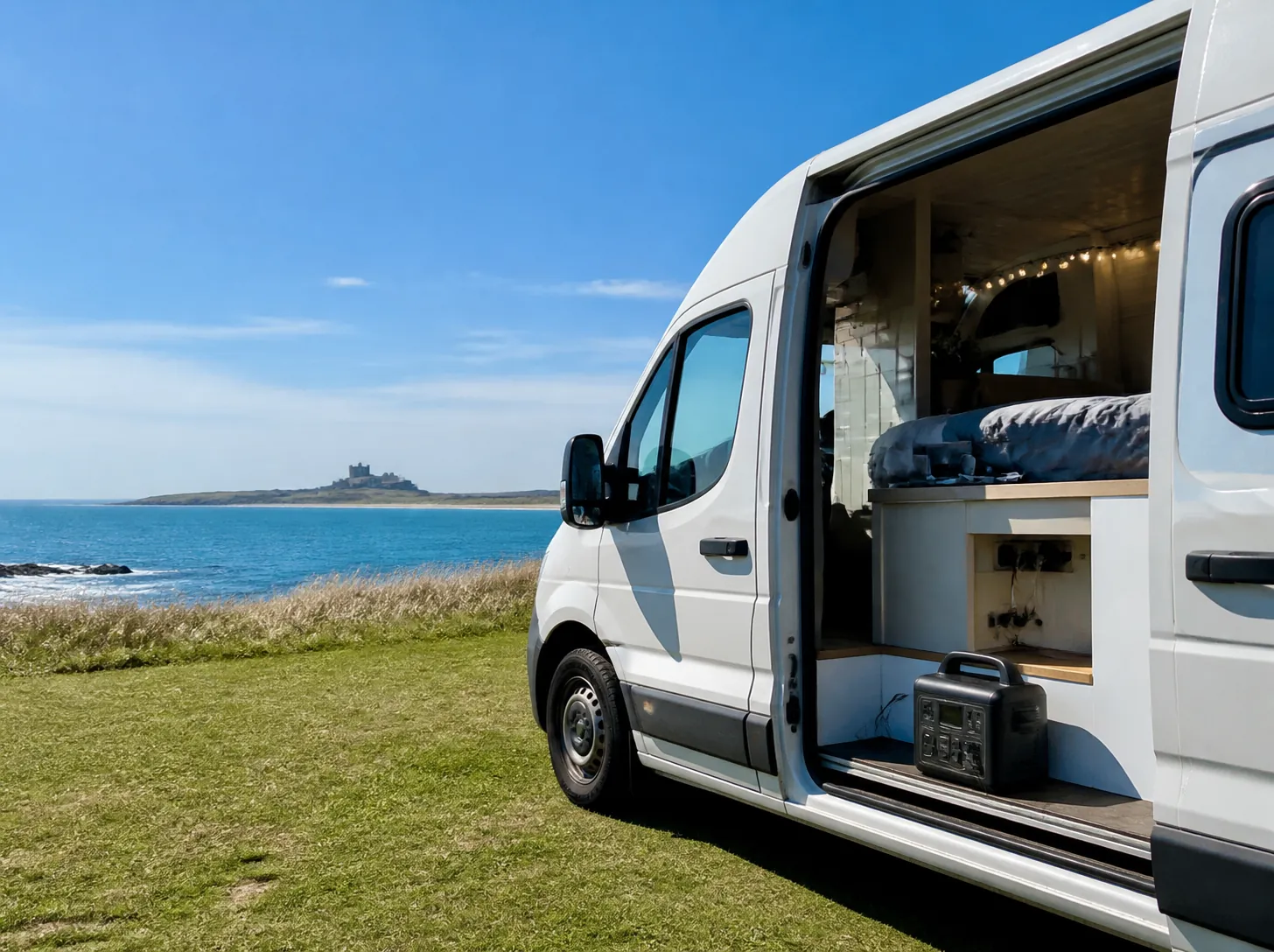
Weight goes up with capacity, so it's the number to check if a station is going in the car or the camper.
Up to about 1kWh: fixed handles, lifted with two hands.
2kWh and up: heavier, so look for wheels and a pull-along handle.
We'll give the exact weight and size on every listing.