Coming soon. Nothing's on sale yet. Join the list on any product page and we'll email you when ordering opens.

Newcastle Solar ShopStorage & kit care
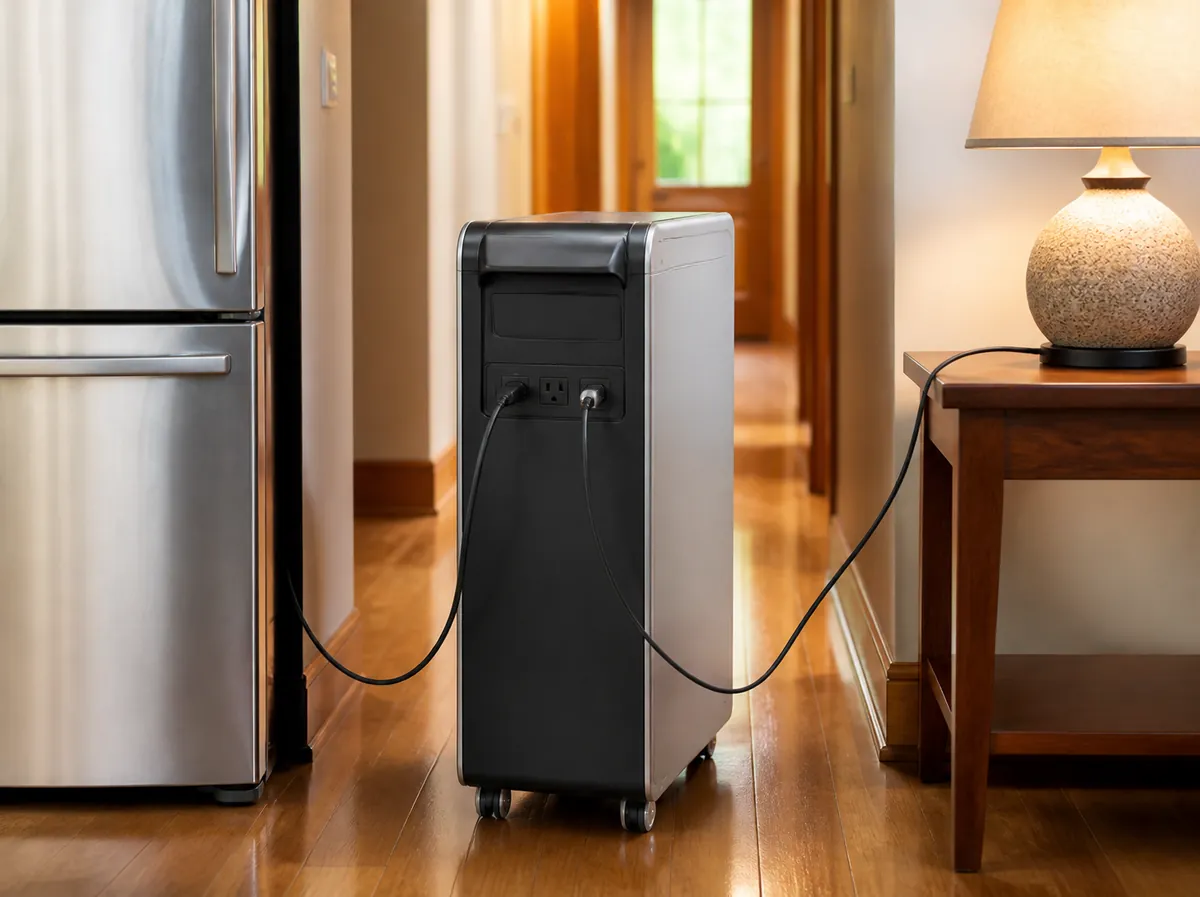
A slim home backup battery unit standing in a bright hallway with sunlight from the front door (illustrative image)Illustrative image
Illustrative image, not the exact model. Photos of the stocked item coming soon.
Line drawing of a 2kwh home backup battery
Our drawing of the type of product. Not a specific model.

Home backup battery

2kWh home backup battery for evenings and power cuts

A bigger battery that stays put indoors. It charges from a wall socket, overnight on a cheaper tariff if you have one, and powers the appliances you plug into it. It isn't wired into your fuse box. Coming soon.

2.0kWhusable. About 1,700Wh reaches the sockets.

Not for use with a plug-in solar kitIt charges from a wall socket, or its own folding panel if the model has a solar input. It never connects to a plug-in solar kit, and a plug-in kit must never be used with a battery.

Availability

Coming soon
Price
Price TBC
Courier to
England, Scotland, Wales
Collect from
Newcastle

Join the list

Nothing here is on sale yet. Leave your email and we'll tell you when you can order.

How we use your email: our privacy notice.

Full specification

The model isn't chosen yet. Each row gets the maker's own figure before it goes on sale, and we don't guess in the meantime.

SpecThis itemWhat it tells you
Usable capacity2kWh class (about 2,000Wh usable)The energy you can actually draw. It's the figure to compare.
Nominal capacityListed when stockedThe total the cells hold. It's always a little higher than usable capacity.
Energy at the socketsAbout 1,700Wh (our planning figure)After the losses of turning battery power into mains power. The model's tested figure will replace ours.
Continuous outputListed when stockedThe most it can power at once, in watts.
Surge outputListed when stockedA short burst for motors starting, such as a fridge-freezer's compressor.
Battery chemistryListed when stockedLiFePO4 (lithium iron phosphate) is the usual choice for a long life indoors.
Rated cyclesListed when stockedHow many full charges until capacity falls to a stated level, usually 80%.
Mains chargingListed when stockedHow fast it fills from a wall socket.
Charge timerListed when stockedWhether you can set it to charge in cheaper off-peak hours.
Switch-over in a power cutListed when stockedWhether it carries on powering what's plugged in when the mains goes off, and how quickly.
Solar inputListed when stockedWhether it takes its own folding panel, and how many watts.
Sockets and portsListed when stockedUK 3-pin sockets and USB outlets.
Weight, size and wheelsListed when stockedWhere it'll fit, and whether you can move it.
Working and charging temperaturesListed when stockedLithium batteries usually won't charge below freezing.
Fan noiseListed when stockedWhether you'll hear it in a living room.
WarrantyListed when stockedHow long, and who handles a claim.

Read usable capacity, not nominal, when you compare batteries. It's the energy you can actually use.
What 2kWh covers after dark

Hours from about 1,700Wh at the sockets, with typical appliance figures. Check your own appliances' labels.

Tap a heading to sort. Swipe the table sideways on a phone.

What's plugged in
Wi-Fi router10170
Two LED lamps16106
Fridge-freezer (average over a day)4042
Laptop in use5034
TV, 43-inch LED6028
Evening set: TV, two lamps and the router8619

Figures are rounded down. Running times shorten if you add more at once.

An evening of TV, lights and Wi-Fi uses a fraction of it. Through a long power cut, it keeps a fridge-freezer cold for well over a day on average figures.

How it charges

  • From a wall socket, like any appliance. With a charge timer and a time-of-use tariff, it can fill up in the cheaper hours.
  • From its own folding panel, if the model has a solar input. The listing will say.

Appliances plug into its sockets. It isn't wired into your home's circuits, so it powers what's plugged into it rather than the whole house.

Never with a plug-in solar kitIt doesn't store power from a plug-in kit and never connects to one. A plug-in kit must never be used with a battery.

Where to put it

  • Indoors, somewhere dry with air around it, on a hard floor.
  • Away from heaters, radiators and anything that could burn.
  • Not in a hallway or at the bottom of the stairs you'd use to get out.
  • Out of reach of small children and pets.

Garages across the North East can drop below freezing in winter, and lithium batteries usually can't charge below 0°C. Indoors is the better spot from November to March.

Questions on this model

Can it store power from my plug-in solar kit?

No. A plug-in kit must never be used with a battery, and this battery never connects to one. It charges from a wall socket, or its own folding panel if the model has a solar input.

Is it the same as a home battery an installer fits?

No. An installed home battery is wired into your fuse box by an installer. This one is a standalone unit: you plug appliances into it.

Will it switch over by itself in a power cut?

Some models keep powering what's plugged in when the mains goes off. Whether this one does, and how quickly, goes on the listing.

Will it cut my bills?

It can if you charge it in cheap off-peak hours and use it at dearer times, but that depends on your tariff and the model's losses, so we don't quote a figure. Its main job is keeping the essentials on.

Elsewhere in the shop